When the environment says stop: backpressure as a governance boundary
An agent operating through a browser is a client of a system it does not control. Rate limits and automated-behavior warnings are not obstacles to route around — they are backpressure, and the correct engineering response is to stop, not to accelerate in disguise.
RBX Systems | Engineering Team
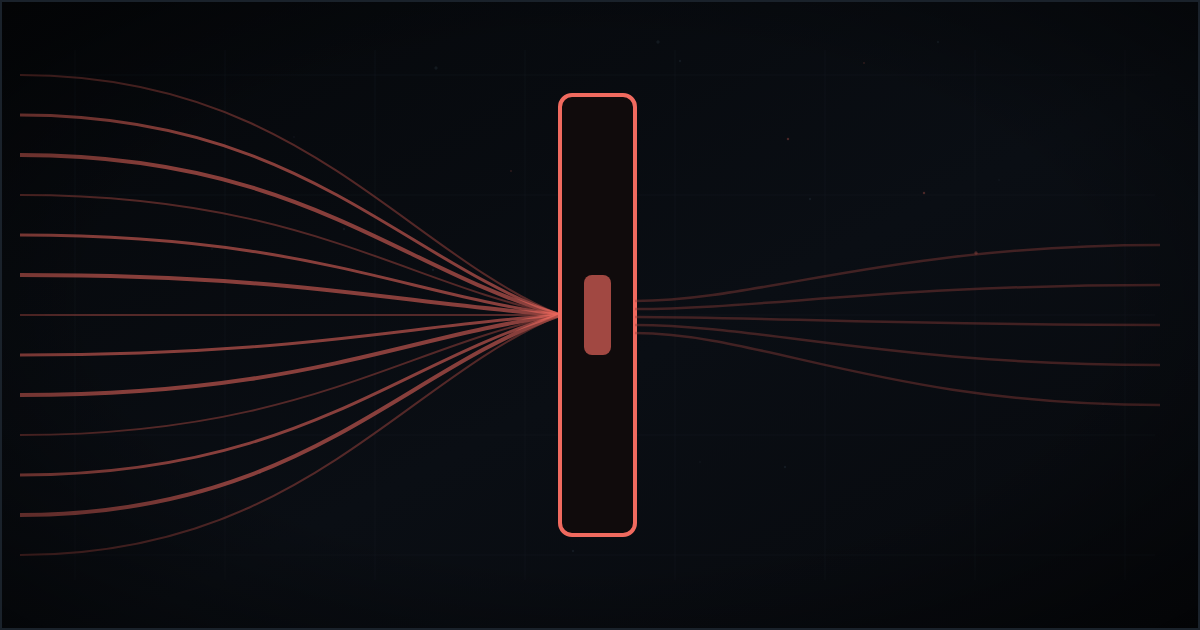
There is a specific temptation that shows up when an autonomous agent starts operating through a browser, against a system that is not its own. The agent runs a repetitive task — reading a long list, applying an action in series — and at some point the system on the other side answers with a limit: "please wait a few minutes," an error code, and later a warning that it has detected automated behavior. The temptation is to treat that signal as a bug to be routed around: randomize the intervals, switch paths, spread the load until detection stops noticing. It is the wrong reading, and it is expensive.
The signal is not noise. It is information about the agent's own aggregate effect, emitted by the one party that has the full measure of that effect: the environment. A rate limit is backpressure. A suspicion warning is backpressure with more emphasis. The correct engineering response to backpressure was never to push harder; it is to reduce throughput, and when the signal escalates, to stop.
The agent is a client of a system it does not control
An agent that only generates text is a draft generator. An agent that drives a browser is something else: a client of distributed systems, operating against third-party infrastructure, subject to every boundary that implies — and to one more, absent from the classic model. In the traditional transactional system, the server on the other side is yours, or belongs to a partner under contract. At the operator edge — the layer where an agent acts through the same interface a human would use — the server on the other side is not yours, holds no automation contract, and maintains its own defenses against clients that behave like robots.
That changes what counts as correctness. The question is no longer only "did the action succeed?" but also "does the environment still recognize me as a legitimate client?" An agent that completes the task and burns the session's credibility did not achieve a partial success; it transferred a cost to the future and to the account it operates.
Backpressure is a first-class signal
In mature distributed systems, backpressure is treated as part of the contract, not as a failure. A queue that signals saturation, a service that answers "slow down" — the well-built client complies, because the signal carries information the client does not have on its own: the aggregate state of the other side.
The operator edge has the same contract, only less explicit. A platform's graduated response — first a soft rate limit, then the persistence of that limit, then a behavioral warning, and finally an action block — is a complete backpressure channel. Each step says the same thing with rising urgency: this client's access pattern no longer looks human, and the distance between "slow down" and "I will suspend you" is shrinking.
Reading that channel correctly requires inverting an instinct. The optimization reflex — find the minimum interval that still gets through — is exactly what produces the robot signature that trips the next step. Interval regularity is the strongest signal of automation there is: a human generates irregular, bursty access, with long pauses and deceleration; a loop generates a metronome cadence. Randomizing the intervals to "throw off" detection treats the surface symptom and leaves the deeper signals intact — volume incompatible with what an interface renders, sweep depth no person reaches, absence of the telemetry a real client would emit around each read. The path that lowers risk is not the more elaborate disguise. It is to access less, and more slowly.
Self-throttling is design, not configuration
The design consequence is that an operator-edge agent's pace has to be a deliberate layer, held to the same seriousness we give idempotency or the reconciliation of unknown results. Not a fixed sleep between actions — that is the metronome again — but a regime.
A self-throttling regime has recognizable parts. Intervals sampled from a long-tailed distribution, so that most gaps are short and a few are long, as in human behavior, rather than constant with a cosmetic jitter. Session budgets, with per-hour and per-day ceilings, that make the agent stop before it accumulates suspicious volume. A circadian window, because an account that acts at three in the morning every day at the same minute gives itself away. And longer breaks interleaved, because no person runs forty identical actions without interruption. None of this makes the agent indistinguishable from a human, and that is not the goal. The goal is to be a considerate client of someone else's infrastructure — which, not coincidentally, is also the lowest-risk behavior.
There is a symmetry here with a thesis that already guides RBX's agentic engineering: surround the probabilistic core with deterministic points. The model decides what to do; the pacing layer decides, deterministically, how fast and whether to proceed at all. The model has no vote over the session budget or the hourly ceiling, just as it has no vote over a lifecycle hook that blocks an execution. Throughput is policy; it is not the agent's decision in the moment.
The stop is a boundary, not a parameter
The most important part of the regime is what it does in the face of a block signal. A rate limit, an automated-behavior warning, a verification challenge: each of these is a stop boundary, and the correct handling is the same one we give an unknown result in the trading runtime. The agent does not fabricate a local verdict, does not retry the same endpoint, does not go looking for the alternate route. It stops, records the signal, and hands back control. If the platform asks "was this you?", the answer is not to confirm through the automation — it is to dismiss the challenge and end the window. A block at these points is final by construction: there is no argument from the model that reverses it, because the boundary is not in the model.
Treating the stop as a boundary, and not as a parameter to be loosened, is what separates governed autonomy from stubborn automation. Stubborn automation sees the warning as friction and optimizes against it. Governed autonomy sees the warning for what it is — the counterparty exercising the right to define how its own infrastructure is used — and recognizes that right as a legitimate limit, of the same kind as a human approval or an exceeded budget.
Reciprocity with someone else's infrastructure
Beneath the mechanics there is a principle, and it is worth naming plainly. An autonomous system operating against shared infrastructure has an obligation not to externalize its costs onto it. Being a considerate client — accessing at the cadence the environment tolerates, stopping when it signals, never treating its abuse controls as an adversary to be defeated — is at once the ethical posture and the more reliable one. The two coincide, and not by accident: the mechanisms a platform uses to protect itself from robots are, almost always, direct measures of how much a client is behaving like a good neighbor.
That is why, in RBX's operator-edge architecture, admitting any channel begins with observation, with enforceable limits, a kill switch, and the platform treated as the authority over its own use. Not because caution is an abstract virtue, but because the alternative — an agent that pushes against the limits until it is expelled — is not autonomy. It is an incident waiting for a date.
The environment has a right of veto. A well-built agent knows how to hear it.